"What kind of yoga do you practice?"
This is probably the question most frequently asked of yoga schools in the West. The answers can vary: some practice Iyengar, others Ashtanga, Kundalini, or Vinyasa. But, in reality, if the practice takes place on a mat, the type of yoga one "does" is always a form of Hatha Yoga.
The Origin of Hatha Yoga
Hatha Yoga is the most popular and widespread form of yoga in the modern world, yet its roots are ancient and profound.
Emerging as an autonomous discipline around the 10th-11th century CE, it flourished in India during the medieval period.
It was Svātmārāma who first described it in a structured way in the celebrated text Hatha Yoga Pradipika (15th century), which became one of the foundational works of the yogic tradition.
In his teachings, Svātmārāma describes:
the asanas (physical postures),
the shatkarma (purification techniques),
the mudras (energetic seals),
the bandhas (contractions),
and pranayama (breath control).
All these elements form a bridge towards the meditative state of Raja Yoga, the path of mental control and spiritual realization.
The Meaning of the Term "Hatha"
The term Hatha derives from two Sanskrit words:
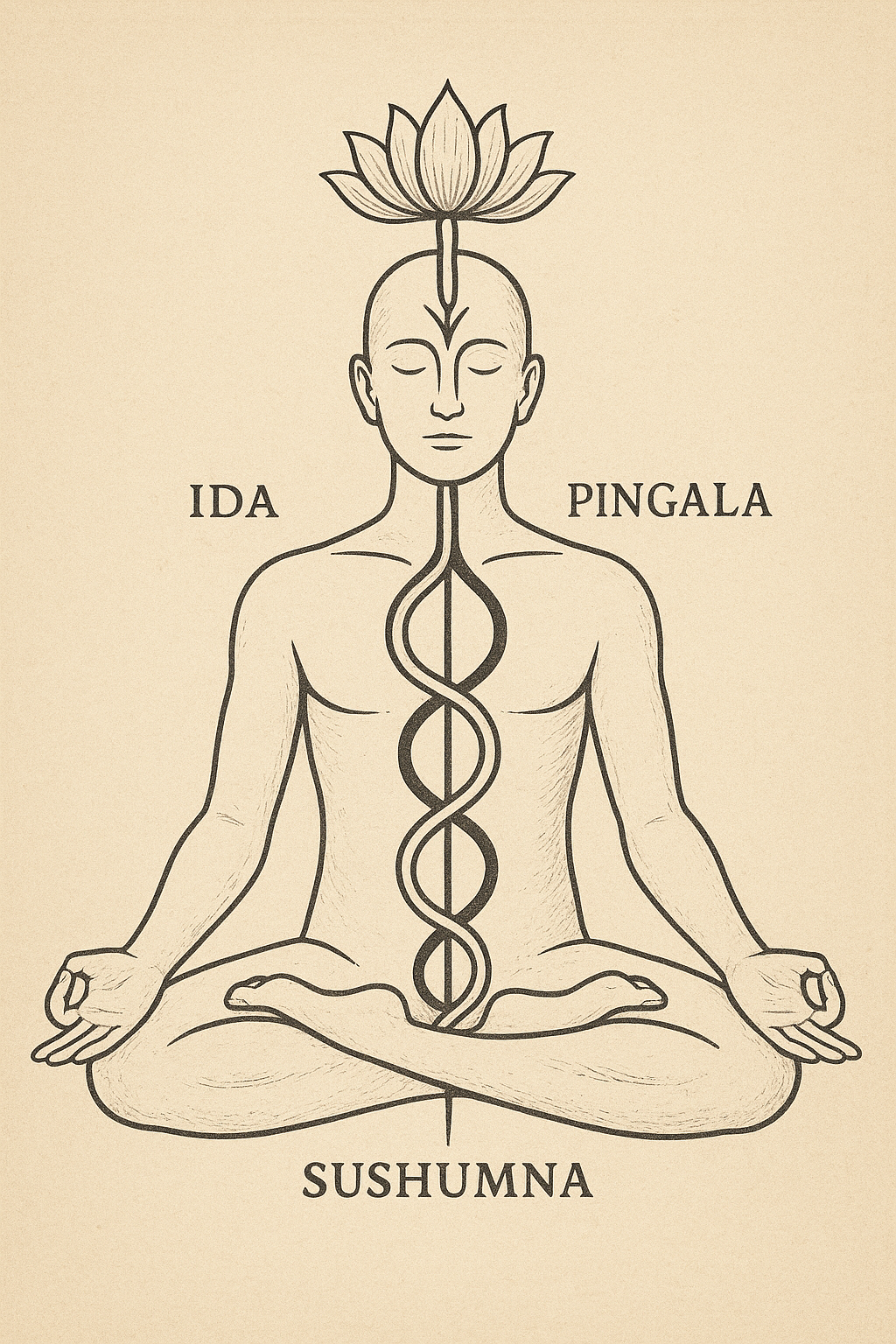
Ha (ह): the solar energy — warm, dynamic, active (Pingala Nadi).
Tha (ठ): the lunar energy — cool, receptive, introspective (Ida Nadi).
The purpose of Hatha Yoga is to balance and unite these two forces in the central energetic channel, the Sushumna Nadi, which runs along the spine.
When these energies harmonize, Kundalini, the latent spiritual energy, awakens and rises towards higher centers of consciousness.
A Path Towards Union
Hatha Yoga has its roots in Tantrism and places a strong emphasis on energy and subtle body awareness.
Its ultimate goal is not merely physical well-being, but the attainment of a state of liberation in life (Jivanmukti): the full realization of the unity between body, mind, and spirit.
Even if we might think we are just doing gymnastics, every time we unroll a mat and practice yoga today, we are retracing a millennia-old path: one that leads to harmony between the two fundamental polarities of our existence — the sun and the moon, activity and rest, the inner and the outer.
Further Reading
Hatha Yoga Pradipika commented by Swami Muktibodhananda
Article on Hatha Yoga Pradipika published by AIYA