"There is nothing more necessary than the superfluous."
So read a maxim by Oscar Wilde. And we, in our modern societies, seem to have taken it quite literally. We have wardrobes ready to burst, homes with so many screens you could get a tan, dozens of brands of toilet paper (?!). In this world, we have vacuum-shoes, smart toothbrushes, and even abstruse concepts like the tattvas.
Actually, no. My apologies, those are not superfluous; the tattvas are the fundamental elements that constitute reality. And if we practice yoga, knowing them might not be superfluous either.
Why is it necessary to know these fundamental elements of reality?
In the path of Yoga and Tantra, the 36 tattvas provide a "map" for liberation. While high-tech gadgets and artificial comforts try to address our frustrations, vrittis and kleshas, the tattvas are tools to emerge from confusion and return to the essence—what is truly needed to live with awareness.
The ultimate goal of yoga is viewed in two ways, depending on the schools of thought.
For Samkhya: The soul (the purusha) is bound by its identification with the emanations of Prakriti (the tattvas, precisely). Liberation is achieved when the purusha learns to discriminate (viveka) itself from all 24 manifest tattvas of prakriti, reaching the state of pure isolation (Kaivalya).
For Tantra: liberation in tantric yoga is not merely discrimination, but the reunification (non-duality) of Purusha with Shiva-Shakti, dissolving the lower and higher tattvas into Absolute Consciousness.
In both cases, practice is nothing but a journey in reverse, to return to the moment when the primordial principles of purusha and prakriti met and generated the reality in which we are immersed.
But really, what are these tattvas?
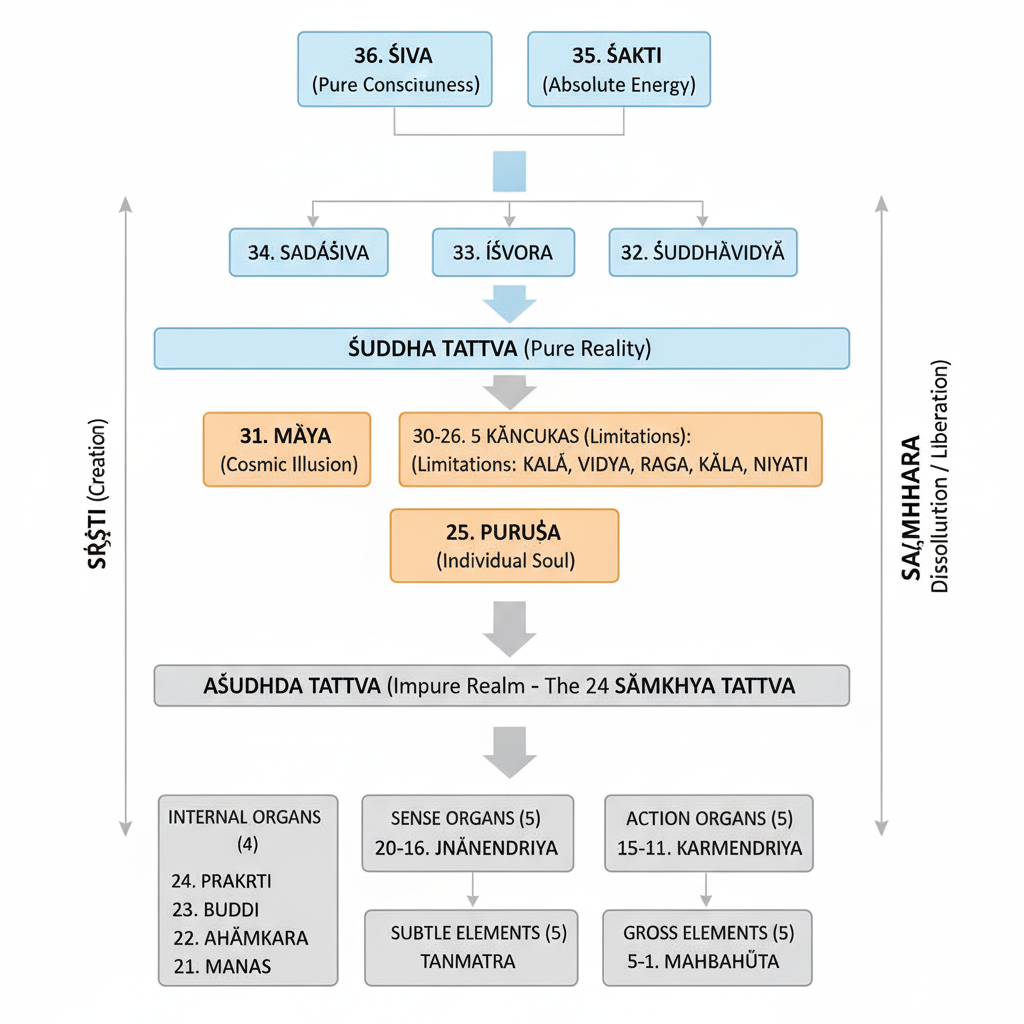
The Samkhya yoga system counts 25 tattvas, also shared by the tantric system, which, however, adds 11 more.
First, we find the aforementioned, from whose union
- 1. Purusha (Consciousness)
- 2. Prakriti (Primordial Nature)
The subsequent emanations to manifest are those related to the "psychic instrument" (we discuss this in more detail here)
- 3. Buddhi (Intellect)
- 4. Ahamkāra (Sense of Self/Ego)
- 5. Manas (The Mind)
Subsequently, reality gives rise to the Five Tanmātras (Subtle Elements):
6. Sound (Śabda)
7. Touch (Sparśa)
8. Form (Rūpa)
9. Taste (Rasa)
10. Smell (Gandha)
In its process of materialization, the absolute then gives rise to the Five Mahābhūtas (Gross Elements)
11. Ether (Akasha)
12. Air (Vāyu)
13. Fire (Tejas or Agni)
14. Water (Apas)
15. Earth (Pṛthivī)
and then to the Five Sense Organs (Jnanaendriyas):
16. Hearing
17. Touch
18. Sight
19. Taste
20. Smell
Even grosser, in the act of emanation, are the Five Organs of Action (Karmendriyas):
21. Speech
22. Hands
23. Feet
24. Organs of Excretion
25. Organs of Reproduction
Tantric yoga (such as that of Kashmiri Shaivism) adds to this manifestation process even subtler levels, precursors to purusha and prakriti. These are spiritual principles, referring to the stages of divine manifestation itself. They are
Shiva
Shakti
Sadashiva (Iccha tattva)
Isvara (Jnana tattva)
Sadvidya (Shuddhavidya or Kriya tattva)
Maya (Cosmic Illusion)
Kala (Limitation of Action)
Avidya (Limitation of Knowledge)
Raga (Limitation of Desire)
Niyati (Restriction/Space)
Kaala (Temporal Limitation)
How necessary is all of this?
Let's get to the point: we need the superfluous because we live in an illusion, and this illusion causes us suffering. The desires that stir our minds and which we try to satisfy with lavender toilet paper and smart toothbrushes are nothing but a fruit of this erroneous conception. Someone, in Vedic times, took the trouble to deconstruct this illusion for us.
The concept of tattvas, especially for those who practice yoga, however complex, is therefore not superfluous. Instead, it is an "essential map" for inner navigation. If modern society constantly pushes us to add, accumulating objects and identifications, the wisdom of Samkhya and Tantra teaches us to subtract. The journey upwards from prakriti (Earth) to Shiva (Consciousness) is the art of discerning what is immutable, the Purusha, from what is mutable, and of recognizing our entire experience as a manifestation of the Divine. In this lies true liberation: recognizing that, to be fully ourselves, we need nothing outside of our Consciousness.
Further Reading
The Doctrine of Vibration by Mark S.G. Dyczkowski
Samkhya Karika by Isvarakrsna, commented by Gaudapada