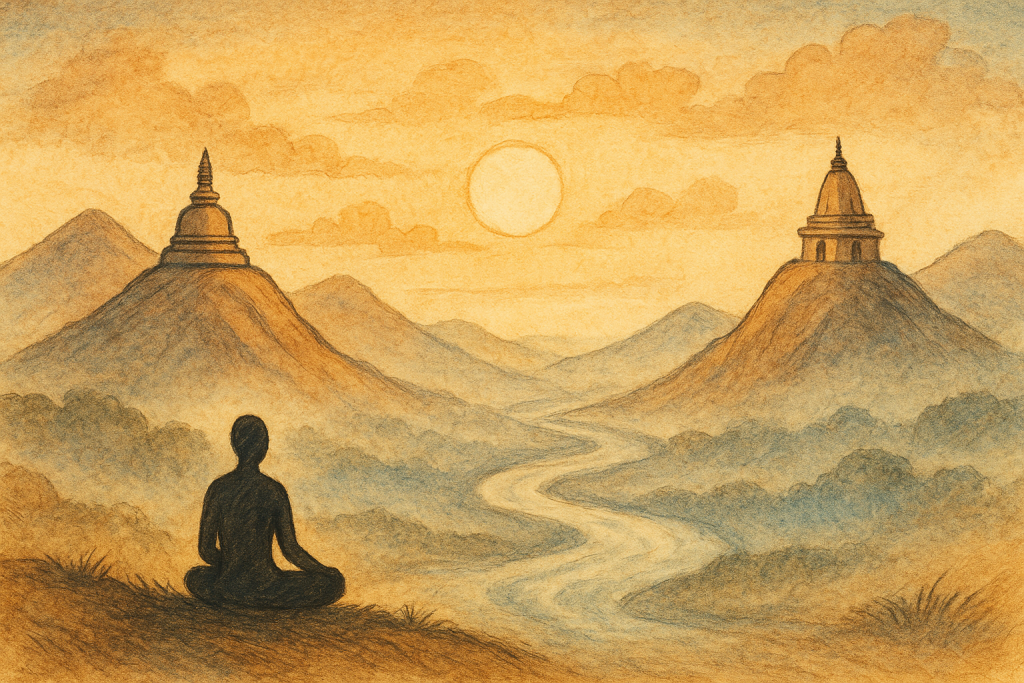
Hypnagogic Travelers
The rishis (sages) who passed down the ancient discoveries and techniques of yoga certainly possessed numerous special faculties and supernatural powers... But they also slept.
However, they obviously did so differently from us: when they slipped into sleep, they managed to remain just vigilant enough to traverse the worlds of dreams and return with new teachings.
Phenomenology of Sleep
This ability to remain conscious at the boundary between wakefulness and sleep is the foundation of Yoga Nidra, the “Yogic Sleep.”
Today, we know that behind this practice lies not only mysticism but also a profound understanding of the nervous system and hormonal processes.
When we fall asleep, the intellect (buddhi) and the sense of self (ahamkara) withdraw. The mind (manas) then begins to move freely within the repository of past impressions and experiences (chitta).
This is why dreams, though lacking logic, reveal contents of our unconscious.
The Rest System
When the rational mind (Buddhi) and the sense of self (Ahamkara) slow down, the body deactivates the “alert pedal,” i.e., the Sympathetic Nervous System, and activates the Parasympathetic Nervous System: that of “rest and restore.”
In this phase, heart rate decreases, blood pressure drops, and the entire organism receives a signal of safety.
The hypothalamus then reduces the production of cortisol, the stress hormone. Only when its nocturnal level is minimal can sleep become deep and regenerative.
The brain slows its rhythms and prepares for the hypnagogic journey, transitioning from Beta waves — those of active wakefulness — to Alpha waves, characteristic of calm and the threshold of dreams.
Waves of Consciousness
Science measures states of consciousness based on the brain's electrical frequency. Yoga Nidra is an intentional journey through these states.
1. Waking State – Jagrat
When we are active, the brain works at Beta frequencies (13–30 Hz). It is the state of concentration, but also of stress.
2. Hypnagogic State – Alpha waves (8–12 Hz)
Just before falling asleep, our mind relaxes and the body stills. It is the first threshold of Yoga Nidra: calm, creativity, and light meditation.
3. Dream State – Svapna
In REM sleep, Theta waves (4–7 Hz) emerge, associated with intuition and deep imagination. Here, the practitioner can “plant” their sankalpa in the chitta: a conscious intention for evolution, which will also act in the waking state.
4. Deep Sleep State – Sushupti
In dreamless sleep, the brain enters Delta waves (0.5–4 Hz). This is the phase of deepest rest and the release of growth hormone, essential for physical repair.
Turiya
Beyond wakefulness, dreaming, and deep sleep, Yoga Nidra opens the door to the “fourth state,” Turiya: a pure presence, free from senses and mental images. It is the state of absolute peace and unified consciousness, where the deepest processes of healing and intuition occur. It is not literally an “additional” state but a dimension of awareness that permeates the other three.
Let's Sleep on It
Perhaps we won't achieve enlightenment through years of waking effort, even by getting up every day at four in the morning.
But who knows, perhaps in sleep, one day, by staying just awake enough to be good observers, enlightenment might conquer us.
Further Reading
Yoga Nidra by Swami Satyananda Saraswati
Why We Sleep: Unlocking the Power of Sleep and Dreams by Matthew Walker