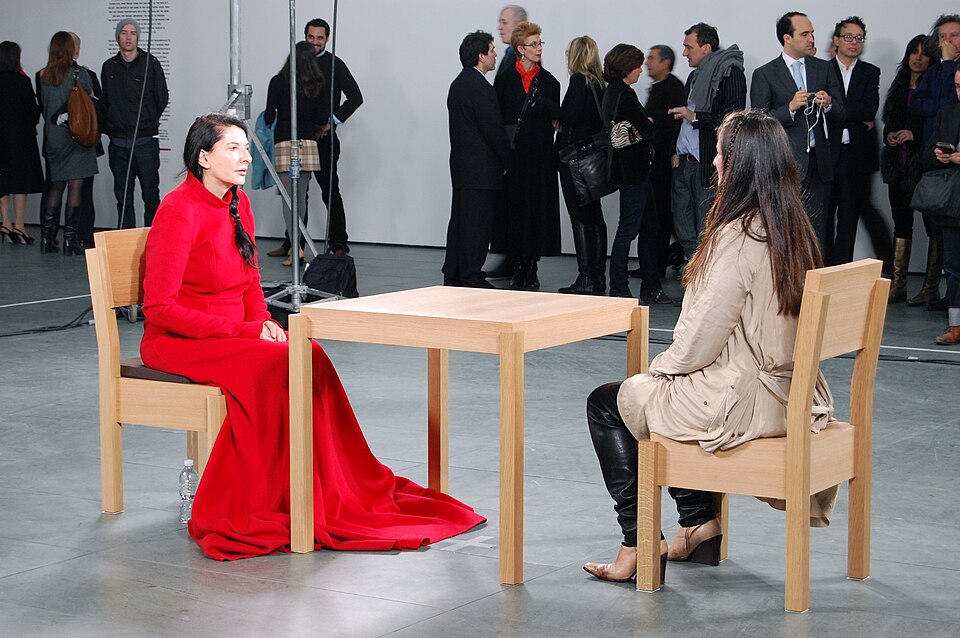
The other day, I came across Marina Abramovic's 2010 performance, titled "The Artist is Present." The performance involved the artist sitting motionless for 700 hours in a museum.
And I thought: how uncomfortable is it to sit there doing nothing?
Better to be kneeling on chickpeas: at least we could complain and have something to do. Probably, after a while, the discomfort would be such that we'd try to distract ourselves anyway. Maybe by picking up our phone.
Sometimes even staying in a yoga pose, an asana, for just a minute can be a challenge. If it's too easy or mechanical, the mind starts to wander. If it's too difficult, it begins to seek an escape. Or it resists.
In both cases, it's difficult to remain "attuned." And perhaps that's precisely the point: if we stay still long enough, sooner or later something emerges.
A thought we were avoiding. A feeling we didn't want to feel. An emotion. A restlessness. Or, "simply," the awareness that there's something in our life that no longer suits us.
Being in the present, then, isn't necessarily as pleasant as we tell ourselves it is.
Because the present isn't just about breath, sun on the skin, and that pleasant feeling of finally being connected with ourselves.
The present also holds all those things we've preferred and would prefer to keep postponing until tomorrow.
And perhaps that's precisely why we're so good at escaping.
Asanas are the third limb of Patanjali's Ashtanga Yoga. Before one can sit in a stable and comfortable position, according to Patanjali, it's necessary to engage with the yamas and niyamas: ten principles concerning how we relate to the world and ourselves.
We won't dwell on all ten here (you can read more here or listen more here) but on three practices that Patanjali groups under the name Kriya Yoga:
Tapas, svadhyaya, and Ishvara pranidhana.
Three practices that, read together, tell us something that might seem obvious: to truly be in the present, we must first have the courage to look within, listen to what we find, and, when necessary, do something about it.
And often it means stepping into that basement where we've accumulated everything for years. And staying there for as long as needed.
Tapas
First, in fact, it takes the courage to stay.
Tapas is generally translated with words like discipline, austerity, ardor. The root of the word evokes heat, fire.
And fire is a good image. Because changing, growing, transforming is rarely comfortable.
It takes energy to begin a practice and even more energy to continue when the initial motivation has faded and when we encounter the first obstacles. It takes discipline to sit on the mat when we'd rather be doing anything else. And it takes a certain resilience to remain within an experience without immediately seeking an escape.
Buddha, speaking of practice, uses a similar image: that of a person who would act with the same urgency as they would try to "extinguish a fire on their own head."
So: tapas can be that fire.
Not because we must live every day as if we're being chased by a fire, but because sometimes we need enough urgency to stop procrastinating.
The problem is that we can postpone almost everything.
Conversations, decisions, changes. We can even postpone ourselves.
Tapas is that small fire that prevents us from continuing to do so.
Svadhyaya
Then, however, an even more difficult part arrives.
To look.
Svadhyaya is often translated as "self-study" or "self-observation." In tradition, it also includes the study and recitation of teachings, but we can apply its principle to something very concrete: learning to observe what happens within us.
Without escaping.
It means, for example, not automatically picking up our phone every time we "feel" bored.
But also, for example, not coming out of a pose as soon as discomfort arises.
Not interrupting an unpleasant sensation with a distraction or an impulsive reaction.
Svadhyaya teaches us to pause for an instant and observe.
What am I feeling? What does this situation evoke or re-evoke in me? What do I want to escape from?
This can happen during a particularly challenging yoga pose. Or when we encounter that person in the hallway who, without having done anything at all in that moment, manages to stir up an infinity of anger, fear, desire, or resentment within us.
The present, in itself, doesn't necessarily need to be changed. We are the ones who relate to it through our tendencies, our desires, and our aversions.
In Patanjali's Yoga, among others, we find two concepts that well describe this mechanism: raga, attachment to what we like, and dvesha, aversion to what causes us pain or discomfort.
I want this. I don't want that.
I like this. I hate this.
This gives me pleasure. This makes me suffer.
And so our relationship with the present becomes a continuous centrifuge of attraction and repulsion.
Svadhyaya interrupts, at least for a few moments, this centrifuge.
But this doesn't mean ceasing to feel something.
It means noticing what we are feeling before reacting.
I am angry. But I can question my anger.
If I am afraid of something, I can observe my fear.
I want to escape; I can ask myself why and from what.
And precisely in that space, tiny but fundamental, between what happens and our reaction, something begins to appear that we didn't see before.
Information. Which is often uncomfortable. Very uncomfortable. But also undeniably true.
And then perhaps we discover that we're not simply tired. We're tired of that job.
We're not simply nervous. There's a conversation we keep postponing.
We're not simply dissatisfied. There's something in our life that we no longer want.
And so being in the present suddenly becomes much less romantic.
The present didn't give us peace.
It gave us information.
But then what do we do with it?
If I observe everything without reacting, where does spontaneity end? On what basis should I act in the world?
Ishvara pranidhana
Here we arrive at the third element of Kriya Yoga.
Ishvara pranidhana.
The term is translated in different ways: devotion, surrender, abandonment to Ishvara.
And the word "abandonment" itself can be misleading.
It doesn't mean stopping doing.
It doesn't mean waiting for the universe to solve our problems.
Nor does it mean convincing ourselves that whatever happens is necessarily for the best.
Rather, it means recognizing a limit.
We can observe, and if we're lucky, also understand.
We can choose, and we can also act.
But we cannot completely control what will happen next.
And this is where the practice truly becomes difficult.
Because perhaps svadhyaya allowed us to see something we would have preferred not to see.
And now we must decide what to do with it.
Change jobs? End a relationship? Say something we were afraid to say? Ask for help? We might also discover that it's not yet time to do anything.
But we must at least stop telling ourselves that we didn't see.
This, perhaps, is one of the deepest meanings of "being in the present."
The present is not a place where we necessarily have to feel good.
It is, however, the place of truth, where we can finally become aware of how we are doing.
And if this awareness doesn't guarantee us a solution, it does remove one of our greatest escape routes: that of being able to continue telling ourselves that we didn't know.
Ishvara pranidhana can then be the next step.
After having the courage to stay, after observing what emerges, we can acknowledge the fact that we will never be able to know all the consequences of our choices.
We cannot control the future. We are only granted to be present to what is happening now.
We can gather the information the present offers us. And then we can act.
Not because we know exactly where that choice will lead us.
But because we have stopped pretending not to know where we are starting from.
Patanjali, in the second chapter of the Yoga Sutras, groups tapas, svadhyaya, and Ishvara pranidhana under the name Kriya Yoga. That is, the yoga of action.
Perhaps we can also read them as three movements of the same practice:
And then perhaps sitting still, doing nothing, finally becomes possible.
Not because the present has become comfortable, but because I have stopped asking it to be different from what it is. Through tapas, svadhyaya, and Ishvara pranidhana, I have accepted to see things as they are, rather than rejecting or manipulating them.
Regarding Abramovic, I don't know if she has done other performances since 2010. For all I know, after over 700 hours of sitting still, doing nothing, she might even have reached Samadhi.
Or Buddhahood.
Or she might still be there stretching her legs.
Further Reading
Core of the Yoga Sutras by B.K.S Iyengar