A Real Powerhouse
It's hidden deep within, yet it supports our every step. Invisible, yet decisive: a silent guardian of our physical and mental balance.
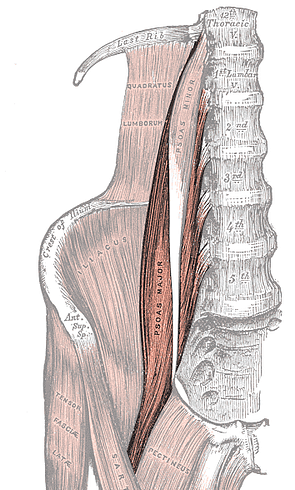
We're talking about a shy and well-hidden muscle, one we rarely perceive: the psoas (or iliopsoas). It is the only muscle that connects the spine to the legs, located deep within, at the center of our body.
It is the primary, fundamental engine of our motor development: without the psoas, we wouldn't have learned to sit as children, nor would we take a single step as adults. It's thanks to its development and activation that, around six months of age, we learn to sit up. It also keeps the pelvis stable when we stand. And it is the main hip flexor, allowing us to walk, run, and bring our knees to our chest.
Beyond Mechanics
Is that all? No, of course not.
The psoas is called the muscle of the soul due to its close relationship with the nervous system and the diaphragm, the primary muscle of respiration.
It is connected to the sympathetic nervous system, responsible for the fight or flight response. Due to its role in locomotion, when we are stressed, anxious, or scared, the body releases adrenaline, and the psoas tends to contract as a defense mechanism (to prepare to flee or curl up). If the threat becomes constant, as in chronic stress, the muscle remains tense.
Furthermore, being in close contact with organs like the kidneys and intestines, its rigidity can affect digestion and circulation.
Caring for the Soul
Caring for this muscle, through practices like yoga or targeted stretching exercises, brings benefits that extend beyond simple musculoskeletal function.
Keeping the psoas strong and relaxed is essential for:
improving posture and the fluidity of pelvic movements;
facilitating breathing, thanks to its connection with the diaphragm;
reducing physical and emotional stress, promoting stability and centering;
increasing vital energy, allowing it to flow better throughout the body.
Caring for the psoas means caring for yourself. When it relaxes, the soul also finds space to breathe.
An Interesting Fact
A small, fascinating detail that tells us a lot about human beings:
the iliopsoas muscle group is composed of the iliacus muscle, the psoas major, and the psoas minor. However, only 60% of the world's population possesses the latter.
Further Reading
The Psoas Book by Liz Koch
Psoas. The Bridge Between Body and Mind by Marcello Chiapponi