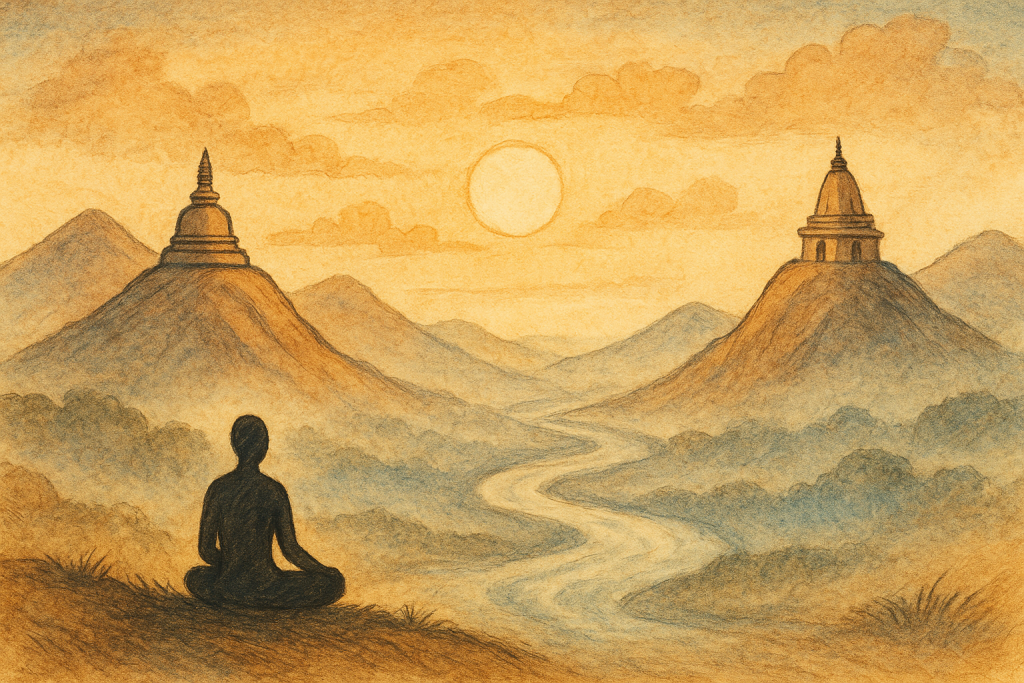
We're speaking figuratively, of course. As is sometimes the case with idioms.
Once at a restaurant, I mistook a stranger for a dear friend of mine (scenes like this often happen to me), but on that occasion, the misunderstanding was particularly obvious and noticed by everyone present. I wanted to die.
The other day, however, someone struck up a conversation with me, telling me things completely irrelevant or uninteresting to me. I was stuck there for half an hour. I wanted to die.
And you? Have you ever wanted to die? Always figuratively speaking, of course.
We often use the expression "wanting to die" as a synonym for relief from an uncomfortable situation. A somewhat extreme relief, certainly, but relief nonetheless. But what if that relief doesn't have to be so extreme? We don't actually have to die to find some peace.
When I made that blunder, the relief I sought was for my wounded ego. A very human error, yet one that created friction with my self-perception and triggered annoying mental chatter. When I was 'held captive' by that person, listening to everything they had to say and more, the relief I sought was from my sense of duty and need to please. If I had been true to myself, I would have told him that what he was telling me interested me less than the results of the curling championship (with all due respect to curling).
The Background Noise We Mistake for Reality
Many times, we would figuratively like to die to finally silence the mind's whirlwinds. In Patanjali's Yoga Sutras, these whirlwinds are called vrittis, and among them is vikalpa: imaginary thought, a mental construction made of words to which no concrete reality corresponds.
Vikalpa is the "mental cinema": it's precisely that mechanism that torments us even in Shavasana. It's the blunder we endlessly replay, the fear of others' judgment that doesn't exist in the present moment, the construction of a catastrophe starting from a simple stumble. In Shavasana, the body is still, but vikalpa continues to play its film.
It's not reality that makes us suffer: it's the story we tell ourselves about reality. It's a true "system bug" of our mind, which projects hypothetical scenarios as if they were real. When we die, along with everything else, those disturbances will also vanish.
The Corpse Pose
B.K.S. Iyengar, one of the masters who most contributed to spreading yoga in the West, wrote that Shavasana is the easiest pose to perform, but the most difficult to master. People who practice with me often confirm this: the body relaxes effortlessly, but the mind resists. It continues to look for something to do, something to cling to, someone to please, or a blunder to ruminate on. Vikalpas don't give up easily.
Yet, once lying down, with a slow, complete, and deep exhalation, we can "breathe our last" and imagine, for a few moments, dying. Allowing the senses to withdraw into what Patanjali calls pratyahara: the fifth limb of yoga, the moment when consciousness stops chasing the external world and returns to itself.
"Dying" in Shavasana
There's not much to do. We just need to lie down in Shavasana. Close our eyes. Take a deep breath and, as we slowly exhale, imagine it's truly our last. Not dramatically, but with relief: finally.
Imagine that after that exhalation, there's nothing left to do, no one to please, no message to reply to, no blunder to make or avoid. No curling championship to feign interest in. Let the senses have nothing left to chase, let thoughts lose the fuel that feeds them and extinguish one by one, like candles at the end of an evening.
It's not sleeping, it's not thinking; it's simply no longer being 'in the game.' Even if only for thirty seconds. But in those thirty seconds, we can savor something we usually only associate with the very end.
Spoiler: it's not scary. There's still breath and there's still a body, and above all, we know there's a before, a during, and an after.
Absence of Friction
When we truly die, hopefully as far into the future as possible, there will be no more thoughts, affections, constraints, attachments, people to please, or blunders to avoid. We can grant ourselves that absence of friction every time we lie down in Shavasana, decide to 'die,' and let the senses have nothing left to seek, because there's no more game to play. Only the inner gaze remains.
Allow yourself to 'die' every now and then; Shavasana was given to us precisely for this.
Important Note: This text explores the philosophical and meditative concept of Shavasana (the corpse pose) as a tool for deep relaxation and detachment from daily stress. If you are experiencing profound suffering or have thoughts related to suicide, please do not bear this burden alone. Seek help from a professional or contact support services:
- Telefono Amico (Friendship Line): 02 2327 2327 (or via web at www.telefonoamico.it)
- Emergencies: 112 or 118
- Samaritans Onlus: 06 77208977
Further Reading