How Many Bodies Do We Have?
I'm in the living room, sitting in front of the computer. My sthula sharira is a bit uncomfortable on this folding chair I'm sitting on, and my hands are touching the keyboard. Meanwhile, my sukshma sharira is observing the monitor and feeling the contact of the keys under my fingers. And my karan sharira? Well, offhand, I wouldn't know, but it's probably dealing with my samskaras or my vasanas.
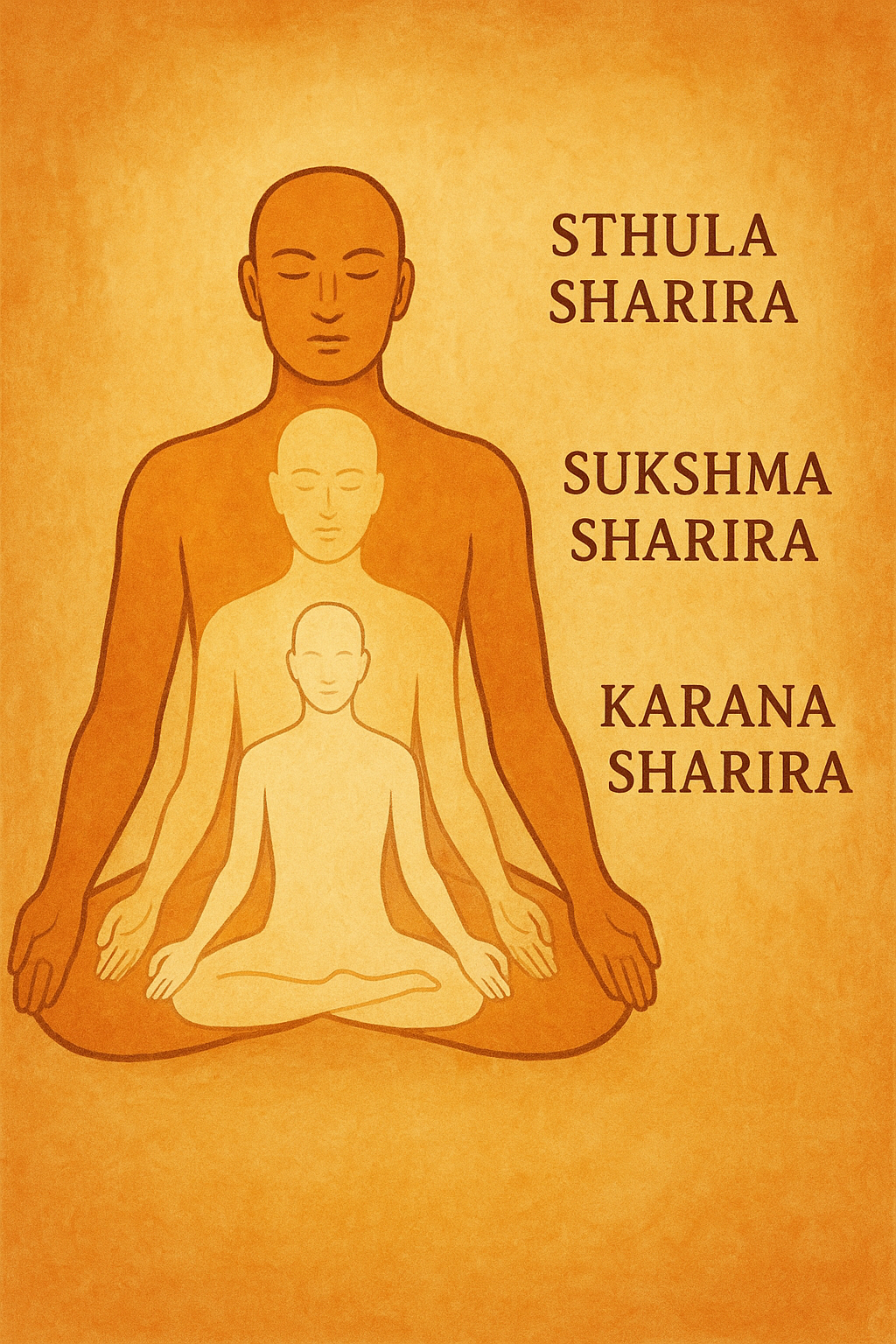
I, like you who are reading, have three bodies through which I experience the world. The Tri-Sharira are three perspectives through which we come to know and transform ourselves as we progress in our practice.
Yoga and the Tri-Sharira
In another post, I discussed the koshas, the “sheaths” that enclose the self and serve as guideposts on our path to liberation.
The concept of the three bodies intertwines with that of the koshas and completes its vision: both guide us from the physical (sthula) to the subtle (sukshma), and finally to the causal (karan) plane.
Sthula Sharira — The Gross Body
It is the part of us that we see, touch, and experience through the senses.
It arises from the five elements (Pancha Mahabhutas): earth, water, fire, air, and ether, which form tissues, organs, and bones.
It corresponds to the Annamayakosha (“anna” means food), the outermost of the koshas, and is associated with the waking state (Jagrat Avastha).
Through asanas and conscious nutrition, we purify and strengthen this body, the concrete foundation of our experience.
Sukshma Sharira — The Subtle or Astral Body
It is the energetic body, that which gives life and movement to the physical body and allows for inner experience.
It contains 19 subtle elements (organs of action, organs of perception, five pranas, and the four mental faculties).
It connects to three koshas:
Pranamayakosha, the vital sheath, where energy flows through the nadis and chakras.
Manomayakosha, the mental sheath, the seat of thoughts and emotions.
Vijnanamayakosha, the sheath of knowledge and discernment.
It is associated with the dream state (Swapna Avastha): when the senses are silent, the subtle body continues to experience, creating the dream world.
Karan Sharira — The Causal Body
It is the subtlest form of existence, the cause from which the subtle and physical bodies emerge.
It has no distinct parts: it is an undifferentiated state that contains samskaras (karmic impressions) and vasanas (latent tendencies) accumulated over time.
It corresponds to the Anandamayakosha, the sheath of bliss: deep joy and serenity, though still veiled compared to the Atman.
It is associated with the deep sleep state (Sushupti Avastha), where mind and senses are inactive, and an unconscious peace is experienced.
Through meditation (dhyana) and introspection, this body is also transcended, to recognize the Self, pure consciousness and bliss.
Returning to the Source of All
For yoga, there is no original sin, but a mission: to experience the world and return to the creative force, Brahman.
It is not an easy journey, but it is a possible and already traced path. And it begins every time we unroll our mat.
Further Reading
"Science of Yoga" by Ann Swanson
"A History of Indian Philosophy" by S. Dasgupta