A Break from the Rules
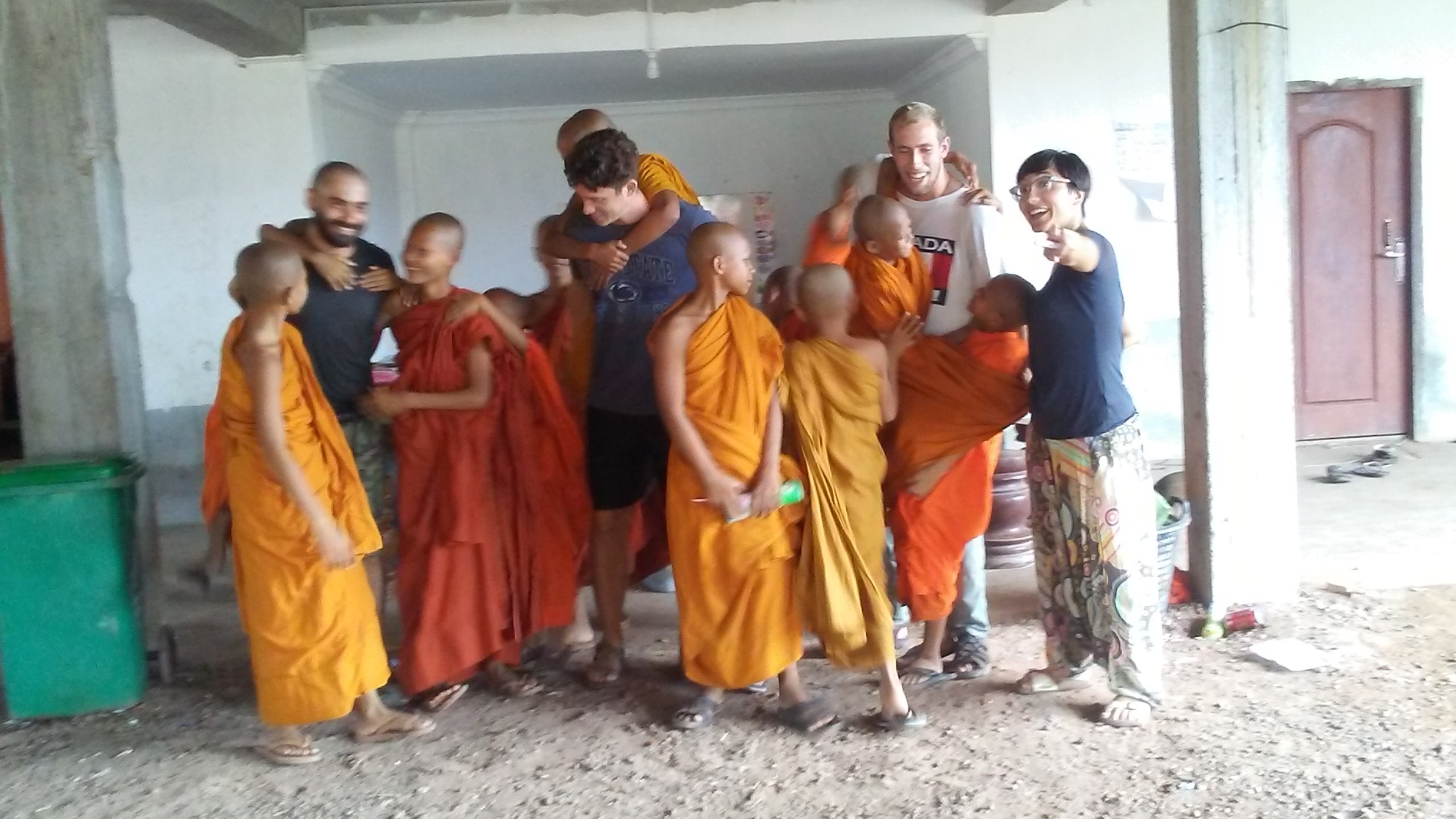
Some years ago, my partner and I were volunteering in a village in Cambodia, where we taught English in local after-school programs.
One group of our learners consisted of young and very young Buddhist monks. You should know that Theravada monks live in extremely austere environments, where every gesture that is not slow and dignified is forbidden by the Vinaya, the strict monastic law.
Now imagine about twenty of these monks singing an English nursery rhyme at the top of their lungs, while, wrapped in their kasaya (the orange robes of renunciation), they move frantically up and down.
Total Physical Response
Of course, the young monks were not playing wildly in defiance of monastic rules. Instead, they were learning body parts, utilizing a method known as TPR (Total Physical Response).
This method, devised by psychologist James Asher, is based on a simple yet revolutionary principle: we learn better when our body actively participates in the cognitive process. Just as children learn their mother tongue through physical stimuli and motor responses even before they can speak, TPR creates a mnemonic anchor between action and concept. It's not just "learning a word," but "becoming that word."
Why it works (even outside a Cambodian temple)
Movement isn't just for breaking monotony. Engaging the body allows us to:
Lower the affective filter: reduces performance anxiety (who among us is completely immune to it?).
Improve retention: the brain associates the term with a muscular movement, making the memory much deeper and more lasting.
Create connection: yoga and gymnastics, ultimately, are millennia-old forms of TPR applied to self-awareness.
Simon Says: do your Yoga
Today, when I practice or teach yoga for adults, yoga for children, or lead a Postural Gymnastics session, I try to apply that same magic that created a stir within the walls of the Cambodian temple.
Whether it's learning English, re-educating one's posture, or forging one's mind, the secret is the same: listen to the body to speak to the brain.
The body possesses a memory and intelligence that we rarely allow ourselves to tap into, delegating all the burden (and honor) of learning and deciding to the brain. How many times do we forget to breathe, to drink, or to listen to a physical signal simply because the rudder is too firmly in the hands of the rational mind?
TPR teaches us that when we manage to make these two powerful tools collaborate, every obstacle falls, even causing the extremely austere Vinaya to capitulate.
Further Reading
Learning Another Language Through Actions by James Asher
The Embodied Mind by Francisco Varela