Tamasic Mats
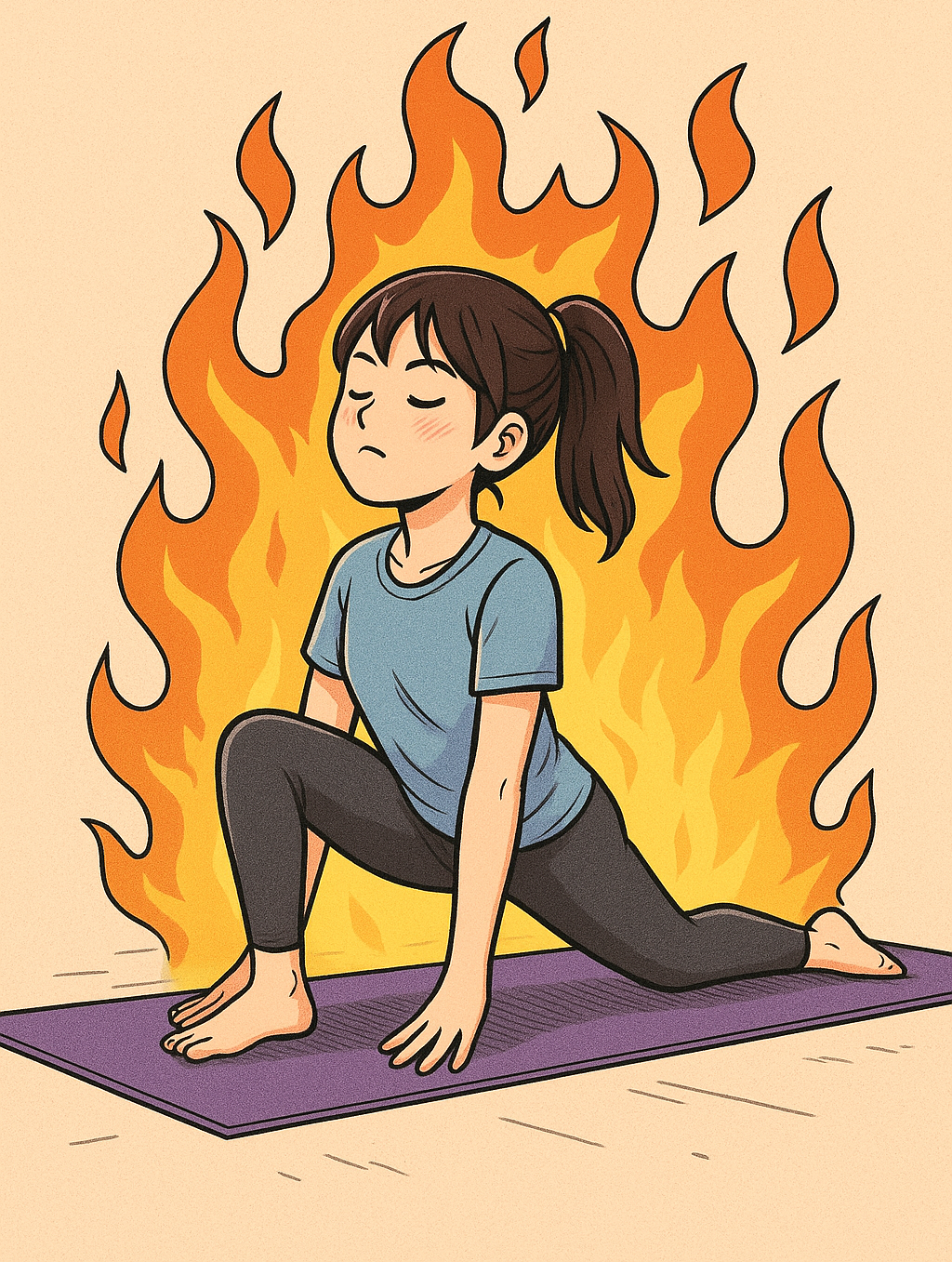
Caught up in more pressing commitments and daily grind, many times we end up on our mats only at the end of the day, tired and with our minds clouded by everything we carry with us.
If we're particularly lucky, maybe it's even winter, we're cold and just want to do shavasana under a nice blanket.
As much as we love yoga and the practice, it happens. The mind gives in to inertia (tamas) and wants no part of it.
Fortunately, the rishi, who had a supreme understanding of the human mind and soul, left us many methods to address this inertia.
One of these is Ujjayi breath, or Ujjayi pranayama.
The Victorious Breath
The Sanskrit term ujjayi derives from the root ud- / ut- (“to rise”, “to lift”, “to expand upwards”) + ji (“to conquer”, “to overcome”) and is translated as
“he who rises”, “who conquers”, “who expands”, often rendered as “victorious breath” or “lifting breath”.
This technique indeed dissipates sluggishness, improves vascularization, draws heat from the periphery towards the center, and guides the nervous system from “I can’t do it today” to “okay, I’m here, present and now.”
The Technique
Accessing this treasure, always available to us, is very simple. After inhaling deeply.
You exhale as if you wanted to “fog up a mirror,” but with your mouth closed. The throat slightly constricts. Almost like when you are about to snore.
The air passing through the slightly contracted glottis will produce a sound similar to that of the ocean, or to put it less poetically, similar to Darth Vader's breath.
On the next inhalation, maintain the same constriction.
Then continue to exhale and inhale continuously and fluidly for a few minutes without forcing.
Often this breath also accompanies the execution of asanas, especially during sun salutations. It is an internal metronome; its slow and resonant cadence helps synchronize each movement with an inhalation or exhalation, keeping you always present.
Why it truly works
In a few cycles, the breath becomes warmer and deeper. Microcirculation activates, sluggishness slips away, and the mind's intelligence becomes available again. It's not magic, but physiology.
1. Controlled increase in intrathoracic pressure
The slight constriction of the glottis slows down the airflow. This creates micro-variations in pressure within the chest that promote mechanical thrust on the vascular system, improving local circulation.
2. Better oxygenation and thus more active tissues
Breathing more slowly and deeply increases oxygen saturation and the efficiency of gas exchange. More oxygen means better-nourished and better-supplied tissues.
3. Parasympathetic activation and thus slight vasodilation
The slow rhythm (like that of the sea!) and the regular sound of Ujjayi calm the autonomic nervous system. This tends to reduce stress-induced vasoconstriction and promote moderate vasodilation, especially at the peripheral level.
Try it to believe it
"And here I was filling myself with vitamins! Can it really be that easy to shake off inertia and regain focus?"
One of Gautama Buddha's teachings (Kalama Sutta) was not to blindly believe what he or tradition said, but to experience things directly.
If you've never tried it and still have doubts, the next time you step onto your mat with a feeling of tamas, take a few minutes just to practice Ujjayi before starting your asanas or during sun salutations.
And discover if you will approach the practice... victoriously!
Note on Contraindications
Like the entire practice of yoga, Ujjayi Pranayama must also be approached with awareness. Avoid it or proceed with extreme caution if:
You have a fever or inflammation (e.g., acute sore throat).
You tend to hyperventilate or feel dizzy during practice.
If you suffer from panic attacks or anxiety, try to calm your breath first. Pranayama empowers what we hold within: if we are distressed, anxiety might increase.
Further Reading
Theory and Practice of Pranayama by B.K.S. Iyengar