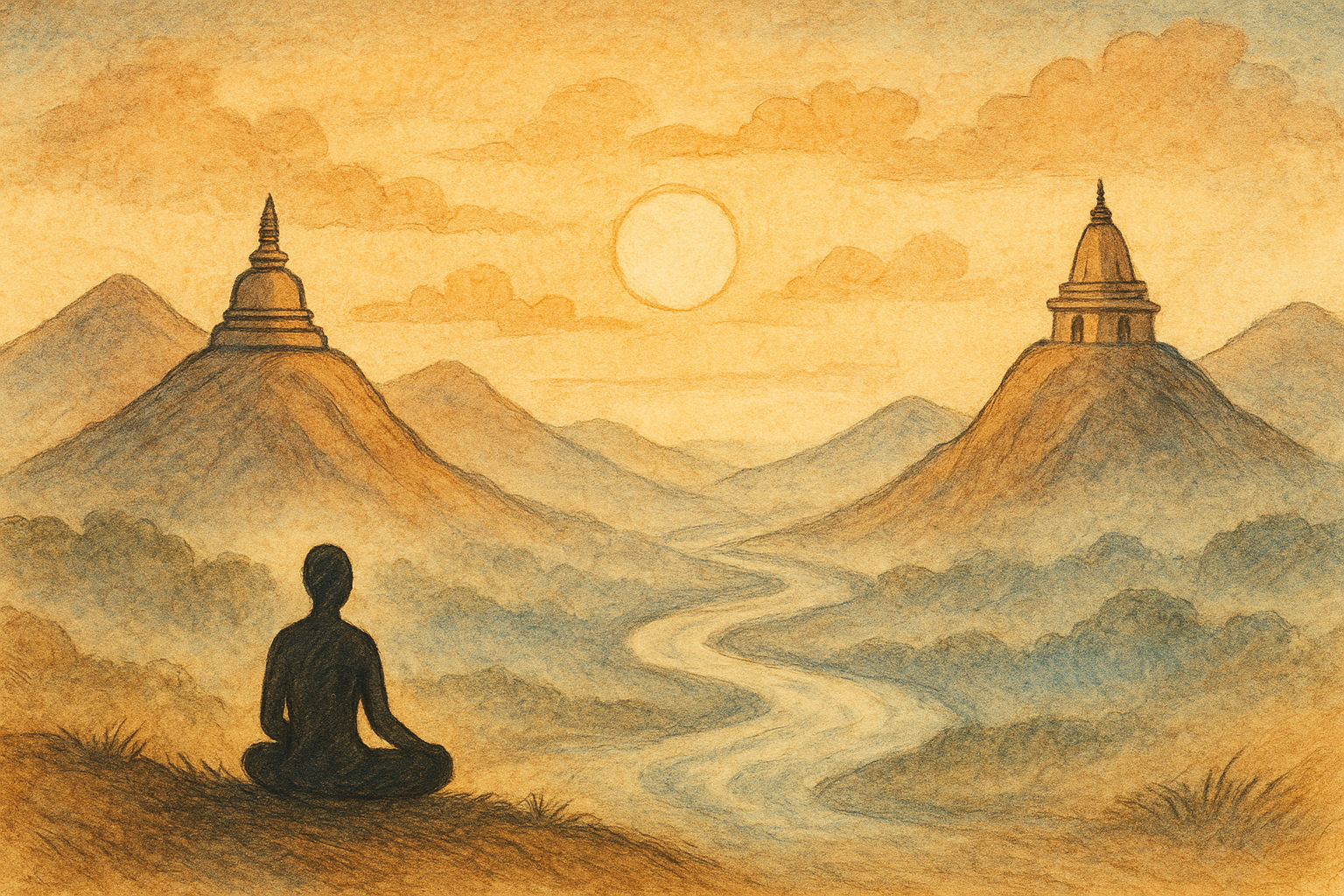
If we were to close our eyes and imagine ourselves in a spiritual landscape, where would we imagine ourselves to be?
Probably many people, like myself, would imagine themselves in some remote Asian location, perhaps Tibet, with a temple, a pagoda, or a stupa on the horizon. A place likely of Buddhist tradition.
And it is undeniable, in fact, that there is great spirituality in Buddhism, yet, precisely in Buddhism, there is no "spirit."
Emptiness
One of the fundamental concepts professed by the Buddha is indeed shunyata, or "emptiness": the total absence of intrinsic existence, a permanent substance, or an autonomous self in all phenomena, and thus of the foundation of the soul and of God.
For Buddhists, all things exist in relation to others ("interdependence" or pratītyasamutpāda) and indeed, it is precisely the attachment to the idea of a self or intrinsic existence that is the fundamental cause of suffering.
Absolute
Yoga, on the other hand, for the Advaita school, literally means "union" (from the Sanskrit root "yuj") and the union in question is precisely with that absolute denied by Buddhism.
Even for the Dvaita (dualist) school, in which Purusha and Prakriti remain two distinct entities, they are nevertheless permanent substances and therefore irreconcilable with the concept of emptiness.
Another fundamental difference between the two systems is that Yoga recognizes the authority of the Vedas, while Buddhism does not (see Āstika and Nāstika)
Twin Paths
Yet Yoga and Buddhism are like two rivers whose waters follow different paths (metaphysics), but the territories they traverse (practices and ethics) are closely intertwined, and their ultimate goal is the same ocean of liberation.
Although the terms and metaphysics differ, both Yoga and Buddhism indeed posit meditation and concentration as fundamental paths to liberation, which for both is a state of peace, freedom, and transcendence of the cycle of birth and death (Samsara).
Furthermore, the ethical foundations of both disciplines are essentially identical and aim to purify the mind and create the right conditions for practice.
One Single Goal
In short, Patanjali and Gautama Buddha point us to the same path, at the end of which are two different doors. Through them, however, one accesses the same celestial goal: liberation.
Further Reading:
The Wisdom of Yoga by Stephen Cope
Psychology of Buddhist Tantra by Rob Preece