Small Victories
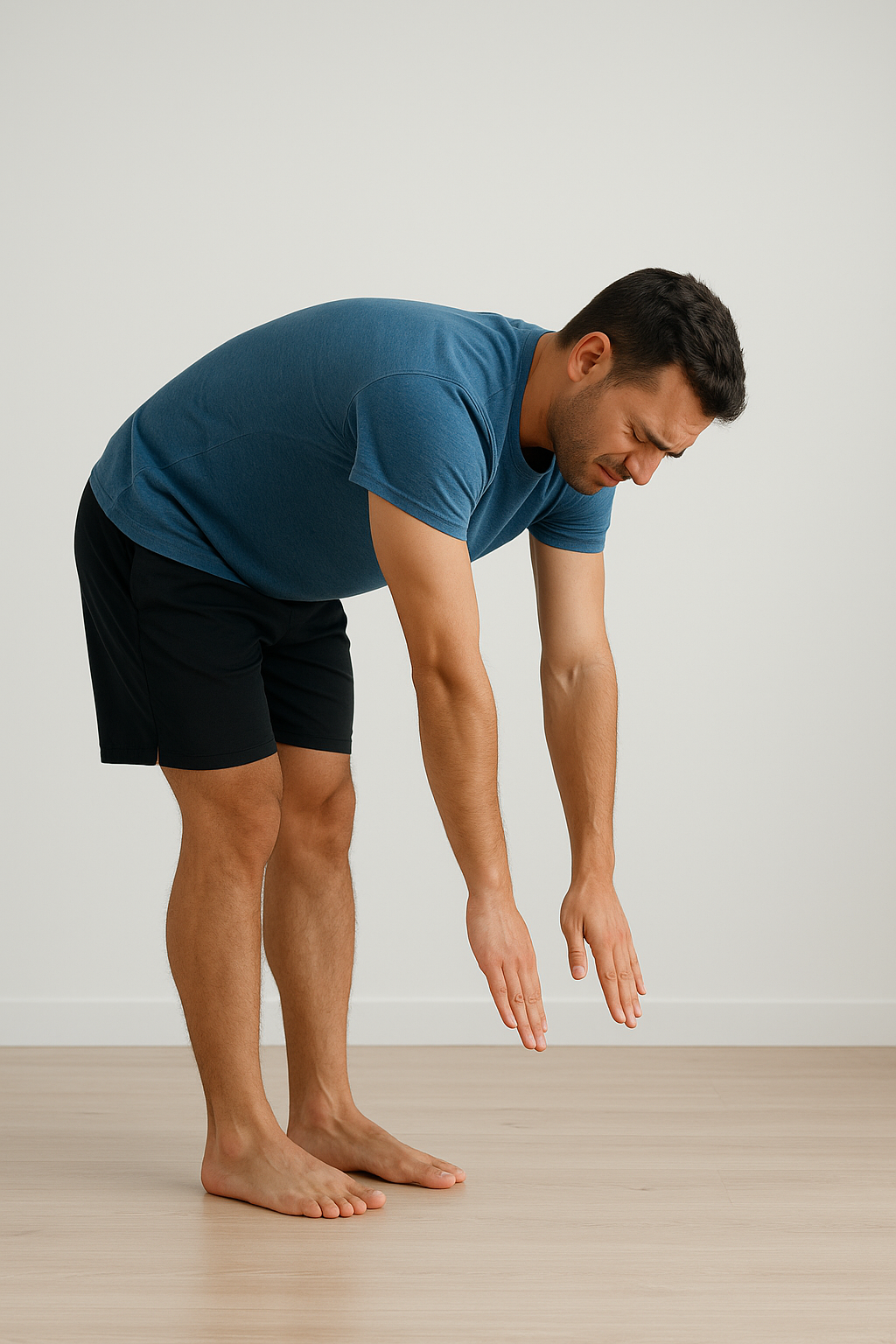
When I started practicing yoga in 2012, I was much younger, and my legs were just as long as they are now. Yet, I couldn't touch my toes. It was a gesture I had taken for granted throughout my youth, but at twenty-seven, it had become a challenge.
Today, it's a feat I take for granted again, but it took years to achieve, with countless Uttanasana and Paschimottanasana (forward-folding poses). Of course, if I had known the secrets of PNF back then, perhaps fewer would have been needed.
PNF: Proprioceptive Neuromuscular Facilitation
There is, in fact, a way to "trick" our muscles and persuade them to exceed their comfort length, upon which they base their safety limits.
By understanding the mechanisms that trigger these limits, it's possible to manipulate them to avoid triggering the alarm reflex and, instead, instruct the muscle to relax. Proprioceptive Neuromuscular Facilitation (PNF) is precisely the technique that leverages these motor control mechanisms.
The Reflex That Blocks Us: The Myotatic Reflex
Within the belly of our muscles, there's a safety device called the "neuromuscular spindle".
When a muscle stretches too much or too quickly, the neuromuscular spindle sounds the alarm.
It sends an impulse to the spinal cord, which immediately tells the muscle to shorten (contract).
This mechanism is the myotatic reflex or stretch reflex, and it's often what prevents us from touching our toes!
The Reflex That Helps Us: The Inverse Myotatic Reflex (Autogenic Inhibition)
However, there's another defense mechanism that works in reverse, called the inverse myotatic reflex.
When a muscle contracts excessively (generating a lot of tension), receptors located near its tendons (the Golgi Tendon Organs) send an impulse to the spinal cord.
This impulse, in turn, instructs the muscles to relax. This mechanism is also called autogenic inhibition (the muscle self-releases).
It's a mechanism that can come to our aid on our journey to touching our toes: by intensely contracting the muscle we want to stretch before subjecting it to stretching, it will yield more easily to the stretch.
The Coordination Trick: Reciprocal Inhibition
There's also another mechanism that regulates our muscles and which we can leverage, called reciprocal inhibition.
It works like this:
When an agonist muscle contracts, its antagonist (the one that performs the opposite movement) relaxes so as not to be an obstacle.
Example: If you contract your biceps (agonist) to bend your arm, your triceps (antagonist) relaxes.
If we want to touch our toes, we can use this principle: contract the anterior leg muscles (e.g., the quadriceps) so that the posterior muscles (the hamstrings, our targets) relax and lengthen.
Know Your Ally, Know Yourself
Slightly rephrasing General Sun Tzu's maxim, we can take home a very useful lesson:
Touching your toes isn't just a matter of flexibility, but of awareness. The body is not an enemy to be forced, but an ally to be understood. Better understanding ourselves, how we are made, and how we respond to stimuli and adversity, is an unparalleled fruit of this listening. Such knowledge can be useful both in the practice of asanas and in every daily aspect of life.
And it's not just about being able to tie your shoes!
Further Reading
Proprioceptive Neuromuscular Facilitation: PNF in Practice by Susan S. Adler, Dominiek Beckers, M. Buck